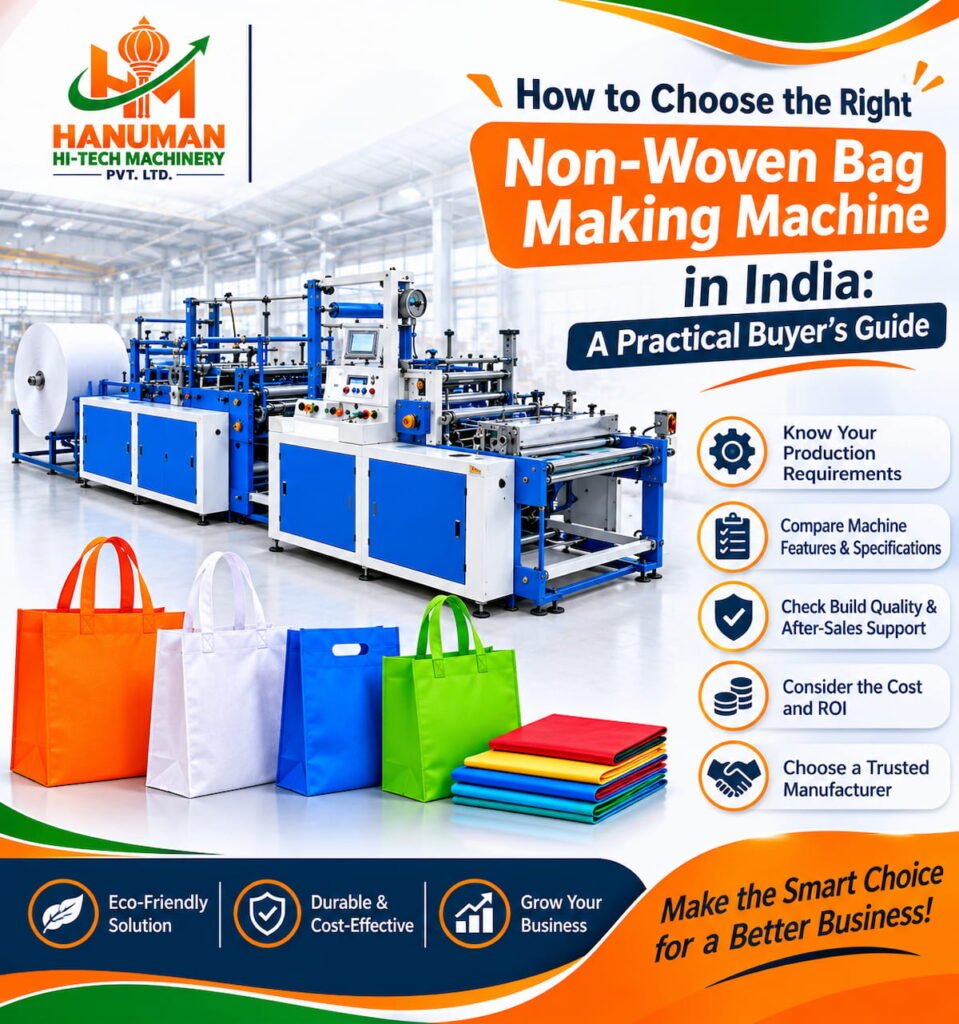
Choosing the right non-woven bag making machine in India comes down to matching your target bag styles, daily production volume, ultrasonic sealing quality, and local spare-parts support. Instead of buying solely on the lowest upfront quote, successful packaging units evaluate machine stability, GSM flexibility, and long-term maintenance costs before placing an order.
Across retail, grocery, medical, and garment markets in India, demand for reusable non-woven carry bags continues to grow steadily. Whether you are setting up a new manufacturing unit or upgrading an existing factory floor, picking the wrong machine configuration can lock your capital into a narrow product range or cause frequent production downtime.
Here is a straightforward, practical guide to evaluating machines, ultrasonic components, and supplier support so you invest with confidence.
Why Your First Machine Choice Shapes Your Profit Margin
In non-woven bag manufacturing, two factories using the same roll of fabric can see very different profitability. The difference usually lies in wastage percentage, sealing consistency, changeover time between bag sizes, and how quickly a technician can replace wear-and-tear parts.
A well-matched machine produces clean, uniform welds at steady operating speeds without burning thin fabric or leaving weak seams on heavier GSM rolls. Before comparing brochures, start by mapping out who your local buyers are and which bag types move fastest in your region.
Main Types of Non-Woven Bag Making Machines Explained
Different buyers require different bag formats. Understanding how each machine category fits into the market helps you avoid over-investing—or buying a unit that outgrows your orders within six months.
1. Standard & D-Cut Bag Making Machines
D-cut bags are the everyday workhorse for pharmacies, apparel shops, supermarkets, and general retail stores. If you want a reliable entry-to-mid-level setup focused on clean cutting and fast turnaround, models such as a Non Woven Carry Bag Making Machine or a compact Non Woven Carry Bag Machine L 500 offer practical control for daily commercial orders.
For factories scaling into high-volume D-cut production with minimal manual intervention, a Fully Automatic D Cut Bag Machine helps maintain consistent bag dimensions and smoother edge sealing across long shifts.
2. Multi-Purpose Five-in-One Bag Machines
If your business plans to serve multiple buyer segments—such as grocery stores needing W-cut (U-cut) bags, boutiques ordering D-cut bags, and wholesalers requesting box or loop-compatible formats—versatility matters. A D 700 Five In One Bag Machine allows you to switch between popular bag styles on a single production line, reducing the risk of relying on just one buyer category. You can explore the full lineup on our Non Woven Bag Making Machines catalog.
3. Loop Handle & Box Bag Machines
Retailers, sweet shops, footwear brands, and corporate gifting suppliers often prefer soft-loop handle bags and laminated box bags because they carry heavier loads and look more premium. Rather than attaching handles manually—which slows output and raises labor costs—dedicated Loop Handle Machines automate handle punching and ultrasonic bonding cleanly, including high-output setups up to 150 pcs/min and BOPP laminated box bag configurations.
6 Practical Factors to Check Before Buying a Machine
1. Your Target Bag Sizes and Fabric GSM Range
List the minimum and maximum bag widths, heights, and fabric thicknesses (GSM) your local wholesalers demand. Confirm that the machine’s web-guiding and folding attachments handle both lighter retail bags and thicker promotional bags without wrinkling.
2. Ultrasonic Sealing System Quality
Non-woven bags do not use thread—they rely on high-frequency ultrasonic vibration to bond polypropylene fabric cleanly. Weak ultrasonic components cause open side seams, uneven embossing, and high rejection rates. Always inspect the quality of the transducer, booster, horn, and generator box.
3. Tension Control and Web Alignment
Uneven fabric tension leads to crooked folds, off-center prints, and wasted fabric rolls. Features like an Auto Tension Controller help keep the non-woven web steady from unwinding to sealing, especially during continuous multi-hour runs.
4. Ready Availability of Spare Parts in India
Even the strongest industrial machine needs periodic maintenance. Before finalizing any supplier, verify whether critical parts are stocked locally in India—not stuck waiting weeks for overseas shipping. Having quick access to genuine Ultrasonic Machine Spare Parts and Ultrasonic Transducers keeps your production floor running without costly delays.
5. Factory Space, Power Supply, and Operator Skill
Check the exact floor footprint required (including space for raw fabric rolls and finished bundles), single-phase vs. three-phase power requirements, and air compressor needs before delivery day. Also confirm whether the supplier provides operator training so your team can manage routine adjustments safely.
6. Supplier Experience and Direct Support
Working directly with an established machinery supplier makes troubleshooting far easier than dealing with middlemen. Learn more about our manufacturing and support approach on our About Us page, or browse our complete All Machinery Catalog to compare configurations side by side.
Why Ultrasonic Components Deserve Extra Attention
Many first-time buyers compare only the outer frame of a machine and overlook the ultrasonic heart inside it. Over months of daily production, horns wear down and transducers run under constant thermal and mechanical stress.
Key components that directly affect weld strength and uptime include:
-
Ultrasonic Horns: Precision-machined parts like a 53mm Ultrasonic Round Horn ensure sharp, even sealing lines without tearing lightweight fabric.
-
Box & Booster Sets: A matched 20KHz Ultrasonic Box & Booster Set delivers stable amplitude so side seals stay uniform at higher speeds.
-
Transducers & Transistor Cards: Reliable units such as a Stainless Steel Ultrasonic Transducer or 15 kHz Hi Tech Transducer, paired with a quality Ultrasonic Transistor Card, protect your generator from overheating and sudden breakdowns.
Quick Checklist Before You Request a Quotation
Before calling a machinery supplier for pricing, keep these four answers ready so you receive an accurate recommendation rather than a generic quote:
-
Primary bag style: D-cut, W-cut, Loop Handle, or Box Bag?
-
Expected daily output: How many hours per shift will you run?
-
Fabric specification: Printed or plain rolls, and typical GSM range?
-
Delivery location: City and industrial power setup available at your shed?
Frequently Asked Questions (FAQs)
1. Which non-woven bag making machine is best for a new startup in India?
For a new startup serving local retail and grocery markets, a versatile multi-format unit like a 5-in-1 machine or a dedicated D-cut bag making machine is usually the most practical choice. It lets you accept common market orders while keeping setup and operation straightforward.
2. What is the difference between a D-cut machine and a Loop Handle machine?
A D-cut machine punches a D-shaped handle directly into the top of the bag, which works well for pharmacies, apparel, and light groceries. A Loop Handle machine attaches a separate soft loop handle to the bag using ultrasonic welding, making it ideal for heavier items and premium retail packaging.
3. Why is ultrasonic sealing important in non-woven bag making?
Non-woven fabric is made from spunbond polypropylene rather than woven cotton. Ultrasonic sealing uses high-frequency vibration to melt and bond the fibers together cleanly in milliseconds without needing thread, needles, or glue—resulting in neat seams and faster production.
4. How important is spare parts availability when choosing a supplier?
Spare parts availability is critical. Wear items like ultrasonic horns, transducers, transistor cards, and tension controllers eventually need servicing or replacement. Choosing a supplier that stocks genuine spare parts in India prevents multi-week factory shutdowns.
5. Can one machine make both D-cut and Loop Handle bags?
Some multi-function bag making machines can produce D-cut, W-cut, and box-style bags, and can pair with separate or inline loop-handle attachment units depending on the model. Always confirm exact attachments and changeover time with the machinery supplier before ordering.
6. Where can I inspect machines or get a custom quotation in Delhi NCR?
You can explore the full range of non-woven bag machines, loop handle machines, and ultrasonic spare parts at Hanuman Hi-Tech Machinery Pvt. Ltd., located at Plot No. 7, Block-B, Badli Industrial Area, Near Samaypur Badli Metro Station, New Delhi – 110042. You can also call +91 92123 27534 or reach out through our Contact Us page.
Ready to Choose the Right Machine for Your Factory?
If you want help matching the right model to your budget, factory space, and target buyers, browse our Machinery Catalog or submit your requirement on our Contact Us page—our team will guide you with clear specifications and current availability.